
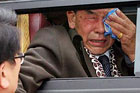
There are thought to be currently 79,258 members of divided families in South Korea, 78% of whom are 70 years old or more. However, only 8.4% have been able to confirm whether their family members in the North are still alive.
According to a joint survey conducted by Metrics for the Ministry of Unification and Korea National Red Cross between April and November, of 128,000 cases of separated families filed, 49,395 are now deceased. 6.3% of the remaining 79,258 are 90 years old or older, 36.6% are 80-90, and 35.1% are more than 70.
The survey was conducted according to the ‘Law on Confirming the Existence of Separated Families and Promoting Exchanges’, enacted in March, 2009, with the target being those separated families registered with the ‘Integrated Information System for Separated Families’, which was launched in 1999 under the same law.
Among the respondents, 13.3% ordinarily live alone and 2.3% live alone because they have no remaining family; 6.2% are receiving National Basic Living Security Benefit, almost twice the rate in the overall population (3.2%).
Only 8.4% of the separated families have been able to determine whether their family in North Korea is alive or dead. For those who have done so, the main methods are: ▲ through relatives in Japan or China (37.7%); ▲ Red Cross exchange events (31.4%); and ▲ exchange organizations (4.1%).
Meanwhile, even assuming they could confirm the whereabouts of their remaining family, only 78.7% said they would like to meet them, and 21.3% said they would not. The reasons for not wanting to meet included: ▲ a death on the North Korea side (33.8%) ▲ the cost of exchanges (17.8%) ▲ already lost contact (9.8%).
Revealing the data yesterday, a Ministry of Unification official said, “In collaboration with the Korean National Red Cross we will produce a ‘Basic Plan for Promoting Separated Family Exchanges’ next year to try and resolve the issue.”
Moreover, the official continued, “We are going to great pains to figure out the best way to be able to have a reunion next year, and once the possible conditions are set, we will suggest a reunion of separated families.”
However, one probable sticking point is bound to be North Korea’s cynical demands for rice and other economic support in exchange for family reunions.