
[imText1]A survey showed that 9 out 10 college students consider the N. Korean human rights problem serious.
Liberty College Students Network(Representative: Lee Bok Hwa) surveyed 403 college students about “the attitude towards social issues” in Seoul from November 6 to 24.
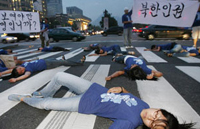
42.1% of the respondents to the N. Korean human rights problem was “very serious” and 48.7% answered “serious”, which implies 90.8% of the respondents understood the seriousness of the N. Korean human rights problem. On the other hand, 7,6% was “so so”, 1.0% “little serious” and 0.5% “not serious at all”.
This survey response was different from that of the past whose respondents showed an inclination towards progressive attitudes in general. This would be because a great deal of information on the N. Korean human rights problem have opened to college students and regardless of the ideological inclinations, they understood how much serious the human rights problem has been .
Regarding the degree of the threat caused by N. Korean nuclear test, 41.0% was “threatening”, 22.5% “Kim Jong Il’s regime is very threatening”, 18.5% “no judgment”, 16.0% “no threatening” and 2.0% “N. Korea is the same family, so not threatening”.
Regarding the necessity of the Korean unification, 39.0% was “necessary”, 15.0% “very necessary”, which amounted for 54% of all respondents. On the other hand, 21.5% was “no judgment”, 18.0% “not necessary” and 6.5% “for a while, unnecessary”.
The fact that “necessary” and “very necessary” are 54% was better than expectations. This came from the trends that college students think N. Korea negatively because of its missile launches and its nuclear test as well as by and large they have inclination toward conservatism.
Regarding political inclination, “a middle-of-the-roader” amounted for the highest percentage, 36.1%, “inclination towards conservatism” 25.9% and “certain conservatism” 3.2%, which showed students who had inclination toward conservatism amounted for 29.1% in total. “Inclination towards progressives” was 25.6% and “certain progressive” 2.2%, which amounted for 27. 8%. “No judgment” was 7.0%.
Regarding the approval rating for the next presidential candidates, Lee Myung Bak, former Seoul mayer, was 49.1%, and Geu Gyun, former prime minister, only amounted for 17.1%.
Park Geun Hae, former representative of the Grand National Party, was 14.1% and Son Hak Geyu, former local governor, 5.5%, Chairman Kim Geun Tae 5.5%, Jong Dong Yang, former chairman, 2.7% and Minister Ryu Si Min 2.0%.
37.9% of the college students supported the Grand National Party and 10.1% Open Uri party, 4.5% Democratic Labor Party and 1.3% Democratic Party in order. On the other hand, 46.0% answered ‘no party’ they support, which showed the seriousness of the political distrust.
In addition, regarding the prospective party and political organization, 20.1% chose ‘the Grand National Party’, 10.2% ‘New-Right’ and ‘Democratic Labor party’ 4.3% Open Uri party and 1.5% Democratic Party.
Especially, the fact that “New-Right” won the second ranking is interpreted like this : the inclination toward conservatism and distrust against the existing political parties led to the high interest in “New-Right Movement” claiming “Right-wing revolution”.
The respondents of the survey were 15 universities: Konkuk University, Korea University, Dongguk University, Myongji University, Sookmyung Women’s University, Yonsei University, Ewha University, Hongik University and the survey method was random sampling and 1 to 1 interview.