

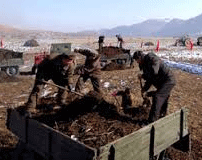
The North Korean authorities have
introduced temporary market restrictions for the first time this year. Taken in the context of the study of Kim Jong Eun’s
New Year’s Address and mass mobilization to produce biological fertilizer
for the agricultural season, the step has led to concerns, as yet unfulfilled in practice, that price inflation could rear its ugly head.
“Recently, the people have been mobilized
from early in the morning until late in the afternoon for the production of fertilizer,
so markets have not been open,” a source from North Korea’s Yangkang Province reported
to Daily NK on the 13th.
“People have been confused by the sudden restrictions. Markets went on as normal when the aunt’s husband [Jang Song Taek] was purged [December 8-12], and they believed the authorities when they said that there would be public distribution [in January],” the source went on.
“If people can’t shop for a prolonged
period because of fertilizer production then prices could rise,” he warned. “People are worried that they aren’t going to be able to make enough
side dishes [dishes eaten with rice].”
“The material that can be made into fertilizer
is limited, so every day people are going around the village hunting for it and
you can even hear quiet complaint about how difficult the whole thing is,” he went on to recall. In
addition, “Some people are openly declaring that the fertilizer task and New
Year’s Address study is all just a nuisance.’
The source explained his presumption that the
authorities, inspired by a good 2013 harvest due to excellent farming weather conditions, are hoping to register further
agricultural production increases this year. Therefore, they have launched the annual mass
mobilization for fertilizer production with greater energy than in previous years, when it was often easier for people to avoid participation with a
small bribe.
“The Marshal [Kim Jong Eun, in his New Year’s Address] ordered that
the farming sector be a priority sector this year, and at Chosun Agricultural
Labor Union rallies they are emphasizing the production struggle,” he said. “Given the fact that
fertilizer is limited they have handed people the task of preparing it, and it
looks as if they want to see big results.”
Market closures don’t stop all trade, however, and at the time of writing market controls had
not unduly affected prices. “Markets are closed up but the price of rice and
side dishes hasn’t changed particularly; rice is being traded as it was last
month in the middle and high 4000 won range,” he said.
However, “A lot of people here didn’t get
rations at New Year, and they are worried that if markets are controlled for a
long period of time then ‘prices could suddenly go up.’”









