

[imText1]A recent article posted by the Youths’ Vanguard attracted my attention. (The Youths’ Vanguard, by the way, is one of the three main newspapers in North Korea, the other two being the Rodong(Labour) Shinmun, published by the Korean Workers’ Party and the Korean People’s Army, owned by, of course, the army.)
In the article, titled “the true image of our society shown in train travel” and posted on August 5, a woman traveling via train from Sariwon, South Hwanghae, to Rajin, North Hamkyung, received benevolent care from her fellow passengers when she suddenly fell into serious ill (the reason was not specified as usual in any other N. Korean newspapers). The Vanguard boasted the passengers “love of comrades.”
The article could be a fiction, if not close to fiction, given that hard years since the mid 90s have created an environment in which struggle of all against all dominates. The popular phrase “all for one, one for all” used to be real, at least by the 80s. However, as famine hit the country, every resident had to fight against one another to survive.
So the custom changed, and now North Korea is run by individualism, as opposed what state media depicts itself.
#1 A soldier-merchant exploiting state owned trains
It was April 18, 1998. I witnessed very discouraging scene while traveling to Shinpo, South Hamkyung, to visit my brother’s wedding.
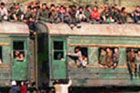
As the train left the Hamheung station, a young soldier was selling tickets to those who already entered (or taking bribery from them). Sitting on a broken empty window, he took 50 North Korean won from every coming passenger, charging fifty more per one pack of luggage. How come?
Because as seen in most of North Korean trains, main entrance was packed with passengers, thus impossible for new ones to get in. The only possible way inside train was through windows. And, moreover, he was soldier!
The soldier took his badge off when an MP came to inspect and did not care much about peoples’ security officers (civilian police).
And he let every paid passenger in, resulting in pandemonium of so many people in so small a place. Passengers fought themselves to have a seat or to just stand still.
Such view had not been unusual until 2000.
#2 A soldier’s unplanned fatherhood
One day in November 1995. I was serving in the KPA.
I was traveling back from the 8th Corps with seven of my comrades and passing through the Yeomju station, North Pyongan. All of sudden, I heard urgent voice calling another soldier in our train.
A young woman was asking a favor, “Please take my baby first. I can’t get into the train holding the baby.” The young soldier, unconsciously, took the baby and waited the woman to ride the train. However, she did not appear until the train left the station.
An older lady on his side said, “How could a young soldier like you raise a kid? In these days, so many mothers abandon their children like this. It is sure she won’t come back.”
Then the poor young man found a letter inside the baby’s quilt.
The letter said “I’m sorry. I haven’t had food for three days. I can’t let my child to starve. Please raise her as a good daughter of the Dear Leader. Her name is Kim Myong Shim.”
These are two examples of popular lives in North Korea in the 90s. Until a decade earlier, North Korean society was quite humane one, possibly more humane than Western societies.
However, as the March of Tribulation passed through the 90s, people changed. They knew only themselves, became selfish.
I left North Korea three years ago. It might have returned back to where people sincerely cared each other.
However, flow of recent defectors still testifies extreme individualism in North Korea.
Knowing the truth, I could only laugh at the Youths’ Vanguard’s sheer lie, which describes, in vain, ‘the true image of harmonious and family-like society under the Dear Leader.’







