

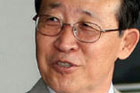
The North’s chief envoy to the Six-Party Talks Kim Kye Gwan said to his Chinese counterpart Wu Dawei that the North is not obliged to declare the alleged Uranium Enrichment Program (UEP) by year’s end, reported Tokyo Newspaper on the 23 of December.
Kim said to Wu Dawei, “Plutonium is the key item that has to be declared,” the Newspaper reported.
Kim was quoted as saying, “We are willing to declare all nuclear programs by year’s end. However, as to the alleged development of UEP, we will offer an explanation demanded by the U.S. at an appropriate time.’” Kim’s words suggest that the North would not declare the UEP this time.
The Newspaper also reported that the North emphatically denied of having any joint nuclear project with Syria. In regard to opening another round of the Six-Party Talks the North said, “It is too early to schedule for the next meeting,” thus indicating that the North would not participate in the Six-Party Talks for the time being.
Sung Kim, director of the Office of Korean Affairs at the U.S. Department of State visited the South on the 19th after his three day visit to Pyongyang. The director is reported to have pressured the North into submitting a complete and correct declaration of all its nuclear programs including the alleged UEP, only to hear the North’s repeated words that deny the existence of the UEP.
The North appears to intend to declare only the amount of plutonium produced at the Yongbyon nuclear reactor and provide an explanation on the intended usage of the produced plutonium. In addition, the North continues to dismiss the U.S.’s allegation of possible nuclear proliferation by the North, saying “the allegation is groundless.”
The North acknowledged the fact that it imported from Russia one hundred and forty tons of high-strength aluminum tube, a key component needed to operate a uranium enrichment centrifuge. However, the North continues to purport that it used the imported tubes to produce rocket bombs, rather than to develop the UEP. In addition, the North denies the allegation of having purchased about twenty centrifuges from Pakistan saying, “the allegation is a fabrication” although the story about the North’s purchase is reported in the autobiography of Pakistani President Pervez Musharraf,
According to the October 3rd Agreement of the Six-Party Talks, the North has to provide a “complete and correct declaration” of its nuclear programs by December 31st. However, as the North appears to exclude uranium from its nuclear declaration list, the U.S. would likely continue to wrestle with the North over the declaration.
Since the second North Korean nuclear crisis started with the issue of UEP, the UEP is the most important item to be declared. In addition, the U.S. has been calling for the North to declare the amount of plutonium and its intended usage and provide an explanation on its alleged nuclear connection with Syria. President Bush’s autograph letter to Kim Jong Il, too, mainly discusses the aforementioned matters.
Unless the North faithfully declares all nuclear programs including the UEP, it is expected that the current warm relations between the U.S. and the North would come to a standstill.
According to a Washington Post report on December 21st, the U.S. founded traces of enriched uranium on the aluminum tubing samples the North had submitted to the U.S. as evidence to dispute the U.S.’s allegation over the UEP.
Although both the U.S. and North Korea will try to come to a compromise as the deadline for the nuclear declaration is a week away, it appears that they would not readily reach an agreement.
Apparently, both countries do not want to ruin the progress made by both parties at the current declaration stage and get back to a state of hospitality as in the past
The North wants the U.S. to remove the North’s designation as a state sponsor of terrorism and lift the application of the Trading with the Enemy Act with respect to the North. Moreover, the North needs 950,000 tons of oil promised in exchange for disabling and declaring its nuclear programs. The U.S., on its part, has been trying to resolve the North Korean nuclear crisis through dialogue despite of all sorts of criticisms. Therefore, the U.S. would not easily give up on its effort to successfully denuclearize the North.
The deadline for the North’s nuclear declaration is approaching. The U.S. and the North will end up either making a compromise or discarding the entire nuclear talk. No matter how that turns out, the declaration will mark a turning point in resolving the North Korean nuke crisis.







