
[imText1]Kim Jong Il praised the past 20 years of Vietnam’s “Doi Moi” economic reform during a visit to Pyongyang by Nong Duc Manh, the General Secretary of the Communist Party of Vietnam. It is reported that Kim Jong Il promised a return visit to Vietnam.
A recent edition of Yazhou Zhoukan, the only international Chinese-language newsweekly based in Hong Kong, reported on the 28th that Kim Jong Il told Nong Duc Manh that he would learn from Vietnam’s reform and open-door policy.
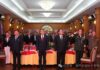
The General Secretary Manh visited Pyongyang with sixty (or so) envoys and had a summit meeting with Chairman Kim Jong Il between October 16-18.
Pham Gia Khiem, Vietnam’s Foreign Minister and Deputy Prime Minister who accompanied General Manh during the summit said in an interview, “Chairman Kim highly valued Vietnam’s achievements during the past 20 years of Doi Moi.”
According to Deputy Prime Minister Khiem, “Chairman Kim said that he wanted to learn about Vietnam’s valuable experience, and he was glad to accept our invitation for a return visit to Vietnam.”
Yazhou Zhoukan also reported that North Korean Prime Minister Kim Yong Il would come to Vietnam to prepare for Kim Jong Il’s visit to the country.
A diplomatic source in Hanoi said, “It is surprising that North Korea is expressing an intention to follow Vietnam’s reforms.” Considering the characteristics of the current regime, however, the source anticipated that North Korea would not recklessly model after Vietnam.
Ever since the adoption of Doi Moi in 1986, Vietnam has promoted reforms and open-door policies including foreign trade expansion, financial market liberalization and market economization. The Doi Moi has brought about remarkable economic growth in Vietnam.
North Korea has been gauging China’s economic reform model. Unfortunately, this did not work well because of China’s unwillingness to support and North Korea’s isolation within the international community. That is why, according to some analyses, North Korea decided to model after Vietnam-style reforms.
It is also reported Kim Jong Il asked Secretary Manh to support North Korea’s efforts to expand its relations with ASEAN countries. While Secretary Manh was still in Pyongyang, the UN announced that Vietnam was elected as a non-permanent member of the UN Security Council for two- year terms.
North Korea warmly welcomed General Manh and his envoys, and restored its friendly relations with Vietnam. It is the second time for Vietnam’s top leader to visit Pyongyang. The first was Ho Chi Minh, the founding father of Vietnam fifty years ago.
Hwang Jang Yop, the former secretary of North Korea’s Labor Party (now the President of North Korean Democratization Alliance, a Seoul-based organization) said on the 28th, “Kim Jong Il took advantage of the General’s Pyongyang visit to show the international community North Korea’s intention of adopting reform and an open-door policy.” Hwang added, “Kim Jong Il will promote the change little by little while keeping his dictatorial role intact at the same time.”
When Kim Jong Il toured the Shanghai Pudong district and other development zones in China in 2000, he remarked that it was “chunjigaebyuk (meaning ‘the cataclysmic change)” and ‘sinsago’ (meaning ‘new thinking’). Upon hearing those words, both South Korean and International media jumped to a hasty conclusion that North Korea would fully promote economic reform and an open-door policy right away.
Yazhou Zhoukan’s report about Kim Jong Il’s praise for “Doi Moi” reforms and his promise for a return visit to Vietnam was released in the midst of discussions about the dismantlement of North Korea’s nuclear facilities and the establishment of a peace regime on the Korean Peninsula. In light of the possibility of a change in North Korea’s foreign policies, the report will likely bring again a controversy over North Korea’s interest in a “Vietnam-style reform policy.”