

[imText1]The Inter-Korea Summit Talks was postponed until October in order to restore the flood damages incurred in Pyongyang. However, interest rises on whether or not restorations will be complete within the short one month period.
On the 18th, chief of United Front Department in North Korea Kim Yang Gun telephoned South Korea’s Chief of National Intelligence Service Kim Man Bok proposing the postponement of President Roh Moo Hyun’s visit to Pyongyang until early October due to the restoration of flood damages throughout the nation.
Though North Korea elucidated that restoration relief would need to be made throughout the country, some analyze that the underlying truth meant it would take at least a month to restore the damages incurred in Pyongyang.
In addition to the preparatory timeframe of the talks being short, others speculate that it is not possible that North Korea would not allow President Roh Moo Hyun to visit the “exhibitory city” known as the revolutionary city of Pyongyang when it was in such ruins.
It seems that North Korean authorities will go to great lengths and invest in equipment as well as manpower to ensure that restorations are completed within the month.
Impossible to restore Pyongyang without mobilizing troops
The Chosun Shinbo, an affiliated news agency with the Chongryon, revealed on the 16th, “Between the 7th and 11th, 224mm of more rain fell than the massive rainfall in the regions of Pyongyang 40 years ago (1967 Aug 25th~29th).” Reports suggest that water levels have reached a high of 2m in some areas of Pyongyang.
The roads around the Botong River and the Daedong River are known to be under water with subway operations suspended for 3~4 stations. The Botongkang Hotel commonly used by foreign tourists is also known to be partly under water as are some popular touristy restaurants and the May 1 Stadium which seats 150,000.
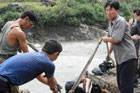
Footages by the Chosun Central TV indicate that a vast area of Pyongyang city is under water. While the build up of mud and earth needs to be cleared, lack of machinery is slowing the process with much of the work being completed by hand.
It seems that soldiers from the People’s Army will be dispatched in Pyongyang to clean up the area. However, in the outer skirts of Pyongyang and other regions, it seems that common soldiers and laborers will be strictly controlled to begin restorative processes. Normally, a person cannot enter Pyongyang without a travel permit and this rule will not be hindered because of restoration processes.
The people mobilized to help in the restorative work in Pyongyang are city residents,
Pyongyang Defense Command, Escort Bureau (the same as the office of the presidential security) and some mechanical engineers. Undoubtedly, all operative machinery will be dispatched to Pyongyang, however, it seems that even this will be insufficient.
Devoting every effort to restore Daesung and Joong-district
First on the list of restorations seems to be the Baikhwanwon-villa where the Inter-Korean Summit will be held and roads around Daesong and Joong-disrict as well as restoring Mt. Geumsoo Memorial Palace. If South Korean delegates visit the North via road as initially planned, then troops and machinery will also need to be mobilized to clean-up the highway from Kaesung to Pyongyang.
With great efforts, North Korean authorities will be able to restore most parts of Pyongyang back to its original state before the Summit opens in early October, though remnants of the flood will undoubtedly still remain.
While the flood itself was a tragic and tough time for North Korea, the restoration period will not be any easier for the people.
In 1995, massive rainfall flooded the lower streams of the Yalu River, a time when the region of Shinuiju was undergoing development. This Shinuiju, Uiju in North Korea and Dandong in China were immersed in water and the restoration period well known.
At the time, Shinuiju was flooded with water up to the first floor of apartment buildings and traffic had immobilized. Buildings in Dandong were also known to have been inundated with water in the lower floors.
One defector Kim Jong Chul (pseudonym) who attended the Kwansoe University in Shinuiju assisted with the restoration process. He said, “There was a junior high school where the waters had swept 50cm of mud onto the classroom floor” and “All the members of the People’s Unit and high schools as well as major universities such as Kwansoe University in Shinuiju, Light Industry University, Cha Kwang Soo University and Manpoong University were mobilized to help the relief.”
He said, “Provincial and city officials formed a ‘Flood restoration committee’ and set orders amidst each unit” and “People used shovels, hoes and practically anything possible to dig up the mud and carry it out on their backs.”
“People would boil and eat unripe corn that had fallen over and eat a bowl of brown rice then get back to work” he said as he reminisced, “Each university got competitive and we would compete to see which university could build a river the fastest.”
This restoration relief which began in early August continued for 3 months until November.
He said, “As for heavy machinery, there was one bull-dozer. But there wasn’t any oil, so the committee proclaimed that anyone who brought a drum (180kg) of oil was exempt from work. Two students offered oil having bought it with money, however, most of the students like myself had no money and so we had to work.”
Regarding the recent flood situation, he said, “Even if they say that the mud and sand will be dug up quickly as Pyongyang citizens are organized, a long time will be need to repaint and restore the buildings.”







