

[imText1]Non-profit radio stations trying to bring information to the North Korean people constantly articulate the dire need for government-sponsored frequencies to be allocated to them, meaning the right to broadcast from within South Korea and massively reduce their costs.
Currently, the South Korea government does not sponsor any radio programs aimed at North Korean citizens, with the exception of the military-run “Voice of Freedom”. Although it runs programs for expats through KBS, the state broadcaster, because this state effort to deliver free, unrestricted information to Koreans abroad is delivered in South Korean dialect, regular North Korean citizens are presumed to have trouble understanding content or idiomatic phrases unique to the South.
This situation persists even though the private South Korean radio stations are basically taking on the government’s responsibilities to the North Korean people. The lack of vital support in the form of government-sponsored frequencies means the private radio stations must appropriate an extravagant amount of money just to rent Shortwave (SW) radio frequencies from foreign governments for a few hours a day.
“What radio stations need right now is local radio frequencies,” agrees President Kim Seung Cheol of North Korea Reform Radio. “Even though the current radio frequency (SW) signal is weak, the programs attract many North Korean listeners. If the stations were able to increase signal strength and clarity through the use of local Medium Wave (MW) radio frequencies, the current radio programs would attract a far bigger North Korean audience.”
Kim Ik Hwan of Open Radio for North Korea says much the same, explaining, “The radio stations allocate most of their budget to the purchase of foreign radio frequencies.“
Open Radio for North Korea, for example, spends more than $100,000 per year on renting radio frequencies alone, leaving little breathing room to innovate and invest in achieving high quality content.
Kim went on, “If the South Korean government were to allocate domestic radio frequency space to the radio stations, then the North Korean citizens would be able to enjoy much higher quality programs, in both sound quality and content.”
The director of Radio Free Chosun, Kim Sung Jung says he believes that the South Korean government is not supporting the radio stations targeting North Korea because it fears repercussions from the North.
As a result, he claims, “The South Korean government is essentially ignoring the right to freedom of information for the 23 million citizens of North Korea,” adding damningly, “the lack of support for these radio stations translates into a lack of respect for the dignity of North Koreans.”
Kim says that there are actually three main reasons why private-run radio stations are the optimal way of addressing the need for information to get into North Korea. First, North Korea cannot officially accuse the South Korean government of spreading propaganda if the radio stations are private. Second, the content of the radio programs is not influenced by change in the South Korean government, as it has been during the Kim Dae Jung-Roh Moo Hyun-Lee Myung Bak period. Third, non-governmental radio stations are better suited to developing and providing specialized programs to meet audience needs.
“The radio programs bridge the cultural and cognitive gap between divided nations, which could potentially save the South Korean government millions of dollars in reunification costs,” Kim concludes. “Appropriating government budget for these non-profit radio programs can also serve as an excellent model for civilian-government cooperation in solving national problems.”
However, Kim recognizes that the South Korean government must walk a fine line as it faces pressure from both the North Korean regime and the South Korean leftist movement.
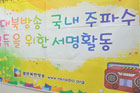
As part of their ongoing fight for assistance, the four main radio stations geared towards the North (Open Radio for North Korea, Free North Korea Broadcasting, Radio Free Chosun and North Korea Reform Radio) are collaborating together to raise public awareness of this issue, starting a nationwide petition and hosting an open air broadcast today, December 15th, at the end of Cheongyecheon in central Seoul starting at 6PM.
[imText2]







