

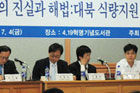
[imText1]Network for North Korean Democracy and Human Rights (NKnet), in a seminar titled “The Truth of the North Korean Food Crisis and its Solution” which was held on the 4th at the April 19th Revolutionary Commemorative Library in Seoul, debated the principal causes of the North Korean food crisis with NGOs and academic experts. They asserted that the principal causes are contradictions within the North Korean regime.
Further, along with the criticism that chronic poverty and mass starvation are unrealistic on an ongoing basis it was proposed that donor nations should lead North Korea to self-driven change, rather than continual emergency aid.
Jiro Ishimaru (石丸次郞), publisher of “Rimjinkang” and also representative of the Osaka Office of Asia Press, suggested that “Since April, the rapid rise in North Korea’s food prices followed an abnormal trend, which was difficult to justify using external factors such as the increase in international prices or last year’s flood. The major factor in this year’s food crisis can be attributed to the internal confusion which caused the “market panic.”
Ishimaru, regarding the results of an investigation into North Korea’s food situation against the backdrop of rice prices as reported by news sources inside North Korea, said, “It is true that North Korea’s food security is the worst it has been since the famine in the late 1990s. As maintained by some organizations, it is unlikely that we can see several tens of thousands of hunger victims, but they are occurring partially.”
“Military-first politics has to be amended in order to overcome poverty…North Korea’s self-preservation has to be encouraged.”
In his analysis, “The recent rise in rice prices has to do with the wholesale merchants who, anticipating the food shortage in the North, intentionally reduced their supply. Wholesale merchants are relatively close to people with influence, so they tried to monopolize the gains from rice sales and to interfere with the circulation in the jangmadang.”
Kang Cheol Hwan, who is the Vice-President of Committee for Democratization of North Korea, pointed out, “North Korea is now divided into the “provision” class, which consists of those relying on foreign aid, and the “self-revival class,” which has grasped the survival power of the market. The recent rise in food prices in North Korea reflects an expansion in the sense of threat due to the uncertainty that has accompanied the change of South Korean administration.”
He clarified, “The provision class, which can be estimated to contain around 5,000,000 people, including Party officials and munitions industry affiliates, occupies approximately 30% of North Korea’s entire population. But, he explained that when food aid comes to North Korea, these class provision persons receive it and become more wealthy and powerful, then they move on to control the circulation of rice and food in the jangmadang while the rest of the population, “self-revival class,” live by relying on trade and must do their businesses in the jangmadang. Therefore, the food aid system can be seen as contradictory to the needs of the North Korean citizens according to the Kang’s explanation.
However, the phenomenon of North Korea’s food price over the end of April and the beginning of May showing a more than 1,000 won decline per day is not logically understandable, so the accuracy issue is problematic.
Ishimaru explained regarding this, “When we get some absurd or extreme results from our investigations, we have been re-confirming the results through our sources within North Korea.”
Jung Gwang Min, a Senior Researcher at the Institute for National Security Strategy who presented “The Main Cause of North Korea’s Food Shortage,” explained, “Strictly speaking, the humanitarian situation in North Korea can be considered chronic poverty, which is not enough to cause famine.”
He noted, “We’ve heard stories that Kim Jong Il killed several hundreds of tens of thousands due to nuclear development.” However, Jung pointed out, “Errors in stories of mass-starvation exaggerate the possibility of a famine occurring and drive international NGOs and governments into short-term emergency aid responses. Whereas, if the North Korean humanitarian situation is described as one of chronic poverty, then military-first politics are fundamentally responsible for that poverty.
He emphasized, “I heard from a high-level official that Kim Jong Il has starved several hundred tens of thousands of people due to nuclear development. The coexistence of military-first politics and economic development is impossible, but if the latter is prioritized, then the military-first policy has to be changed.”
Lee Seung Hoon, Professor of the Economics Department at Seoul National University said, “If North Korea is to get rid of its chronic poverty, then it has to establish and carry out an economic policy that can increase its ability to acquire food. There is a need for the countries providing emergency food aid to the North to request that North Korea implements an economic policy that strives to escape the poverty.”
Professor Lee proposed in detail, “The South Korean government has to form an organization and system of cooperation with all supporting countries to North Korea and unify channels for food aid.”
Related to this, Jo Dong Ho, Professor at Ewha Women’s University, insisted, “The Lee Myung Bak administration’s Vision 3000: Denuclearization and Openness is merely a plan with a slogan, it has not become a policy. A course regarding how long North Korea will continue to receive its food aid, and to what extent, has not been set out. For a fundamental improvement in North Korea’s food security, our government’s policy has to be quickly clarified.”






