

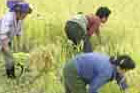
An inside source reported Thursday, October 11th that the North Korean state authorities directed some managers of factory complexes in North Hamkyung province to ration out food enough for a six month period to workers without reservation.
In a phone conversation with DailyNK, the source said, “The Party ordered to the managers and party secretaries in Yangkang and North Hamkyung province that each factory and factory complex must undertake responsibility of distributing six months of food ration for their workers without condition.” The source added, “The order troubles the managers and secretaries.”
The source informed us that this time, the order was more significant than before because the Party announced that it would fire those who fail to carry out the order.
Once again this year, North Korea, in order to resolve food shortage on its own, carried out a policy of distributing certain patches of farmland from collective farms to all workplaces so that they can grow food for themselves and ration the collected crop. In fact, the policy is the same as developing the contract system (a system of distributing farmland to certain numbers of groups and having them cultivate the land and collect the crop) into a factory quota system.
The workers or laborers at each factory or factory complex cultivate the land, and share the crops with all workers during the season of harvest.
However, the contract system has an adverse effect on the workers when not enough land is distributed or when the factory and farmland are too far apart. This is because in many cases, the workers cannot make ends meet after they deduct the expense of cultivation and crop transportation.
The farmland around the city is mostly for vegetable cultivation, and hard to receive because of high competition for such land. Usually, the workers receive farmland which is about forty or eighty kilometers away. It is very difficult to pay the transport costs for workers and crops.
The Party and Regime organizations greatly benefit from the contract system. They seize the best land for themselves and mobilize farm workers for cultivation. During the harvest season, they extort most of the crop, insisting on a farmland quota system.
This policy, known as the self-sufficient food production system for factory complexes, has proved disastrous for most of the ordinary workers. It is under these circumstances that the state authorities ordered that each complex distribute six months of food ration. The order pushed most factory complexes into a corner because they cannot secure food by themselves.
The source said, “Since we have no power whatsoever, our factory received the poorest land, which is eighty kilometers away from the village. We wanted to give up the land. But we had to till the land in rotation anyway since the farm management committee checks and reports our farming activity.”
The source added, “We farmed corn and beans. In autumn, we rented a car and harvested the crops. However, we were left with only 22 kilograms of corn of poor quality after we paid the expense for the car and gas with the crops of good quality. Even so, the mangers and secretaries falsely reported to the state that we had received four months of food ration because they did not want to lose their positions.”
“Under the current situation, the workers must supply, for example, six months of food ration if the authorities order them to do so. Even if the workers fail to meet the order, the party secretaries would report that we have produced that amount, and that they have distributed six months of food ration. However, it is obvious that the workers would not receive their ration after all their hard work.”
A defector from North Pyongan province, Mr. Kim purports that the self-sufficient food production system would greatly benefit only the Party cadres.
The defector testified, “During the harvesting season, the Party cadres behave in a shameful fashion. They never forget to take their ration distributed by the state although they already have enough after the excessive extortion of crops produced by the workers. On the contrary, the powerless workers end up falling into debt.” Overall, the Party cadres practice double extortion by taking food from the quota system and from the state distribution office.
He also added, “Since the situation has come to this, many factory complexes falsify their production results. For instance, if the state directs them to distribute food ration enough for six months, they make a fictitious report that they have produced that amount. After that, the state propagates the report that the complexes have achieved the food distribution task for their workers.”







