
Due to the market restriction policies which have been imposed on North Korean society since the currency redenomination, it is natural that the number of people in the poor classes has been increasing.
A source from North Hamkyung Province confirmed as much yesterday in a telephone interview with The Daily NK, saying, “Lower class people, who live from hand to mouth through the markets, have been suffering from the most serious difficulties since the redenomination.”
This is because for around two months the markets were shut down completely, and even after the markets reopened market price ceilings were adopted, so small traders and those who lived by relying on the markets were among those hit hardest, according to the source.
“Those running street-stands, alley market traders, porters and others who live by clinging to the markets mostly lost their money in the redenomination. Although markets have started to get animated again, these people are still facing difficulties due to a lack of seed money.”
The source added, “The food situation is actually dire. Despite the authorities’ program of releasing relief rice to poor households, in reality real distribution for them is not that helpful.” This is because any such state relief program is temporary, and cannot address the poorer classes’ fundamental problems.
He emphasized, “Now, people have started worrying about spring poverty, which comes every year in around May or June. In Onsung, Hoiryeong and Musan in North Hamkyung Province, the rice price has dropped to around 400 won per kilogram, but there are still so many people who cannot even afford to eat corn.”
The source gave the example of one of his acquaintances, whom he called Mr. Lee. He used to live by trading secondhand products in Musan.
Pre-redenomination, Mr. Lee managed around 200,000~300,000 won (in old value) of assets, dealing parts and used bicycle tires with his wife. However, following the currency redenomination of November 30, 2009, he was left with 1,900 won of new currency.
To make matters worse, he had only 100 kilograms of corn, which he had obtained in October. His family has been eking out that corn over the last few months.
Since February, the Musan Market resumed operations, but since prices have been unstable, not many people have wanted to buy. Recently Mr. Lee was forced to sell his one-room house to realize some capital.
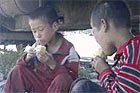
As the source concluded, “The most terrible victims of the currency redenomination, market closures and inflation are lower class people in the cities. Nowadays, city residents feel lucky when they have just coarse corn.”
“In May or June, when the spring poverty period begins, the situation of the urban poor class will become even more terrible.”