
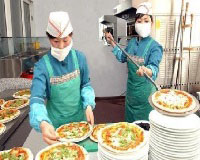
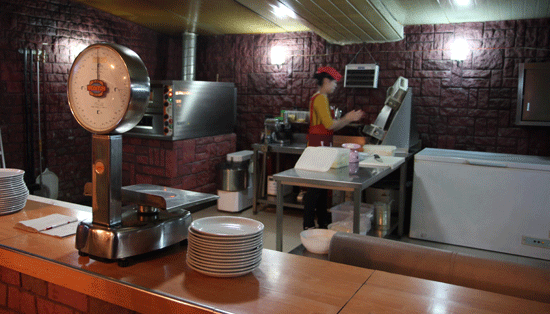
 A Pyongyang pizzeria visited by tourist Andrew Cheng. Image: Andrew Cheng |
Sunchon, South Pyongan Province, has seen the introduction of a new pizzeria, known to be the first eatery serving Western cuisine in any area of North Korea outside the capital.
Tourist Andrew Cheng, who visited North
Korea during celebrations for the anniversary of Kim Jong Il’s birth on
February 16, recorded in his travel journal that there were two pizza restaurants in
Pyongyang, using ingredients purportedly imported from Italy. The ingredients
at this establishment, however, are all imported from China, though it boasts a
professional chef hailing from Pyongyang’s Jang Cheol Ku University, named for
the region where Kim Il Sung ate during the Anti-Japanese Resistance, and
famous for its cooking and hospitality major.
A source in South Pyongan Province reported
to Daily NK on August 27th, “The Neungra 88 Trade Company Restaurant began at
the end of last year, and is very popular among the affluent population,”
adding, “One pizza pie costs approximately 30,000 KPW [$3.50 USD].” He went on
to explain that the variety topped with ground pork is the most popular, as the
authorities do not allow the consumption of beef and dole out harsh punishments
to anyone who kills one without permission; oxen are considered a productive
resource and the sole property of the state.
Knowledge of the term “pizza” does not
exist among most, leading some residents in the area refer to the restaurant’s
staple item as “mixed buchimgae
[pan-fried vegetable pancake].” North Korean authorities actively resist foreign
influences, particularly from the English Language. While South Korea borrows
words from English, North Korea creates indigenous substitutes.
Others refer to the varieties of pies
available as “okonomiyaki [a Japanese
savory pancake] mixed buchimgae.” Okonomiyaki, the only version of a
foreign fried pancake North Korean residents have been exposed to until now, brought in when tens of thousands of Koreans left Japan for North Korea,
encouraged to repatriate by the pro-North Korean Chongryon [General Association
of Korean Residents in Japan].
The source interpreted the restaurant’s
establishment as a sign that “foreign currency-targeted operations have started
to show interest in North Korean money as well.” The restaurant operates under
the “Neungra 88 Trade Company,” an arm of the Chosun Workers’ Party Finance and
Accounting Department charged with procuring foreign currency. The company
usually sells coal and iron-ore, which fetch the most money in China, but also
medication, alcohol, or anything else that may yield financial gains on the black market. Profits
are usually funneled directly back to the Finance and Accounting Department, or
used to purchase lavish holiday gifts for Party cadres, who often distribute trading
licenses, at a hefty fee, to other foreign-currency earning organizations to
procure more money.
Increasing foreign food availability is the
latest method employed by these foreign-currency organizations to encourage
resident spending, encouraged by the increased demand. The popularity of
Chinese-style lamb kebabs spread more rapidly in the North than its Southern
counterpart.
Mooncakes, a traditional Chinese dessert,
have even made their way to family memorial service tables set up during
Chuseok [the traditional Korean harvest festival]. These foreign-currency
earning operations are in fierce competition to bring in culinary traditions
from China, justified as measures to improve the quality of life for North
Korean residents.
The restaurant sits inside the Yeonpo
District of Sunchon City, an emerging business area. An expressway stretching
to the edge of the Taedong River has been constructed to transport Anthracite
[smokeless coal] produced in the coal mines into the city. Cargo handling for the
smokeless coal has shifted from the West Sea port of Nampo, to the inner city
area near the Taedong River, galvanizing business activity in the Yeonpo
District.
Over 100 Chinese-manufactured trucks loaded
with anthracite coal pass through the area daily, giving rise to an expanding
transient population working in the commercial hub, which the source said
continues to fill up with buildings constructed by agencies of various levels
eager to do business there.
Operating from the first floor
of a three-story building owned by the Neungra 88 Trade Company in the
Chiisagata District of the city, the pizzeria incorporates elements of Western
interior design and features an expansive terrace complete with patio chairs to take in
sweeping views of the Taedong River.
“In front of the restaurant there is an
expansive parking lot for its main patrons, the donju [new affluent middle class], to park their vehicles,” he
added,” You can seem them every weekend, sporting sunglasses and coming to
enjoy the mixed buchimgae.” He added
that the restaurant offers take out service but that home delivery is not yet
available.
For foreign currency-earning enterprises to
extend their activities domestically is indicative of the increasing
purchasing power of the middle-class. “Those without will continue to be
without, but those with money can use the power and capital they possess to get
richer and richer,” he concluded.