
North Korean schoolchildren as young as elementary age were forced to march through neighborhoods waving flowers and singing state songs for a full week before the country’s March 15 Supreme People’s Assembly elections, with teachers privately admitting the burden fell almost entirely on students while adults found ways to slip away.
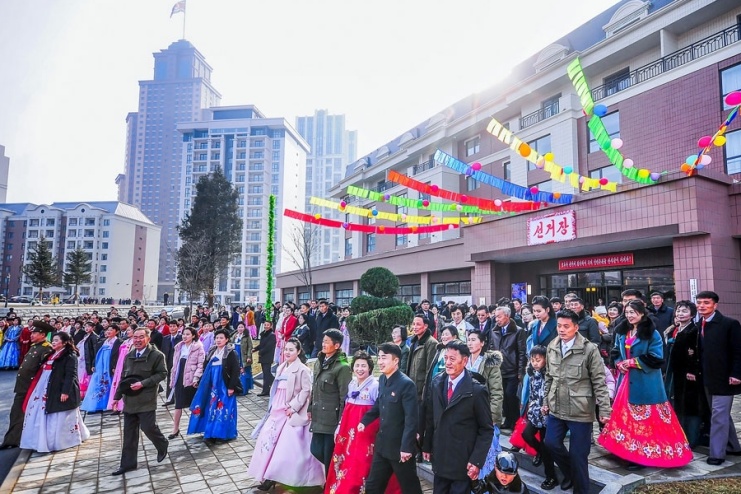
A South Hamgyong province source told Daily NK on Wednesday that students at every school level in Hamhung city were pulled from their normal routines after class each day in the week before the vote and sent into the streets in formations called gachang-dae (singing corps), a compulsory performance of electoral enthusiasm that no student could opt out of without consequences.
Absentees tracked down, pulled from their homes
Schools that fell short of full participation did not simply let it go. Youth league cell leaders compiled absentee lists and reported them up the chain. School officials then investigated each absence individually, and in some cases went directly to students’ homes to bring them out.
The mobilization was organized by instructors from the youth league (Socialist Patriot Youth League) and the Young Pioneers (Korean Children’s Union), who leaned especially hard on students approaching graduation. Their pitch: “Finish out your school life on a high note.” Senior school teachers reinforced the message, telling graduating students they were “lucky to be building these kinds of memories before entering society.”
The source was blunt about what was really going on. “Teachers knew full well the students would be suffering, but because they had no choice but to get them out there, they had to come up with hollow words to make it happen,” the source said.
Meanwhile, teachers themselves rotated breaks after accompanying students for a few rounds, staying mindful of how they appeared to principals and vice principals watching nearby. “In the end, the ones who suffered for hours were only the students,” the source said.
The source drew a sharp parallel to the role North Korean students already play each spring, when they are mobilized en masse for agricultural labor. Students are sometimes called hakgaeng-danji, loosely translated as “student nutrient pots,” a term borrowed from agricultural terminology reflecting how indispensable student labor is to the spring planting season.
“Just as spring farming is impossible without students, they end up doing the heavy lifting for election atmosphere-building too,” the source said. “That’s why teachers joke among themselves that election propaganda is really ‘student propaganda.'”
On election day, some students were out before sunrise
The mobilization peaked on March 15, election day itself. Students were ordered to report to school at 6 a.m. and were then dispatched across assigned precincts to perform gachang-dae activities in the streets.
How long they stayed out depended on the school. Some were released by 11 a.m. Others were kept going until 1 p.m. Older students at senior middle schools bore the longest shifts, with younger children at elementary and junior middle schools rotating out earlier.
The Rodong Sinmun newspaper reported March 16 that the 15th-term Supreme People’s Assembly deputy elections had been held amid what it described as “the surging faith and will of all the country’s people to firmly uphold and glorify the Juche socialist system.” North Korea reported a turnout of 99.63%, a figure consistent with results the country has claimed in every previous election.
Reporting from inside North Korea
Daily NK operates networks of sources inside North Korea who document events in real-time and transmit information through secure channels. Unlike reporting based on state media, satellite imagery, or defector accounts from years past, our journalism comes directly from people currently living under the regime. We verify reports through multiple independent sources and cross-reference details before publication.
Our sources remain anonymous because contact with foreign media is treated as a capital offense in North Korea — discovery means imprisonment or execution. This network-based approach allows Daily NK to report on developments other outlets cannot access: market trends, policy implementation, public sentiment, and daily realities that never appear in official narratives.
Maintaining these secure communication channels and protecting source identities requires specialized protocols and constant vigilance. Daily NK serves as a bridge between North Koreans and the outside world, documenting what’s happening inside one of the world’s most closed societies.